Bodyrebuilding
How diversity work led to chronic pain and a journey to healing through weightlifting
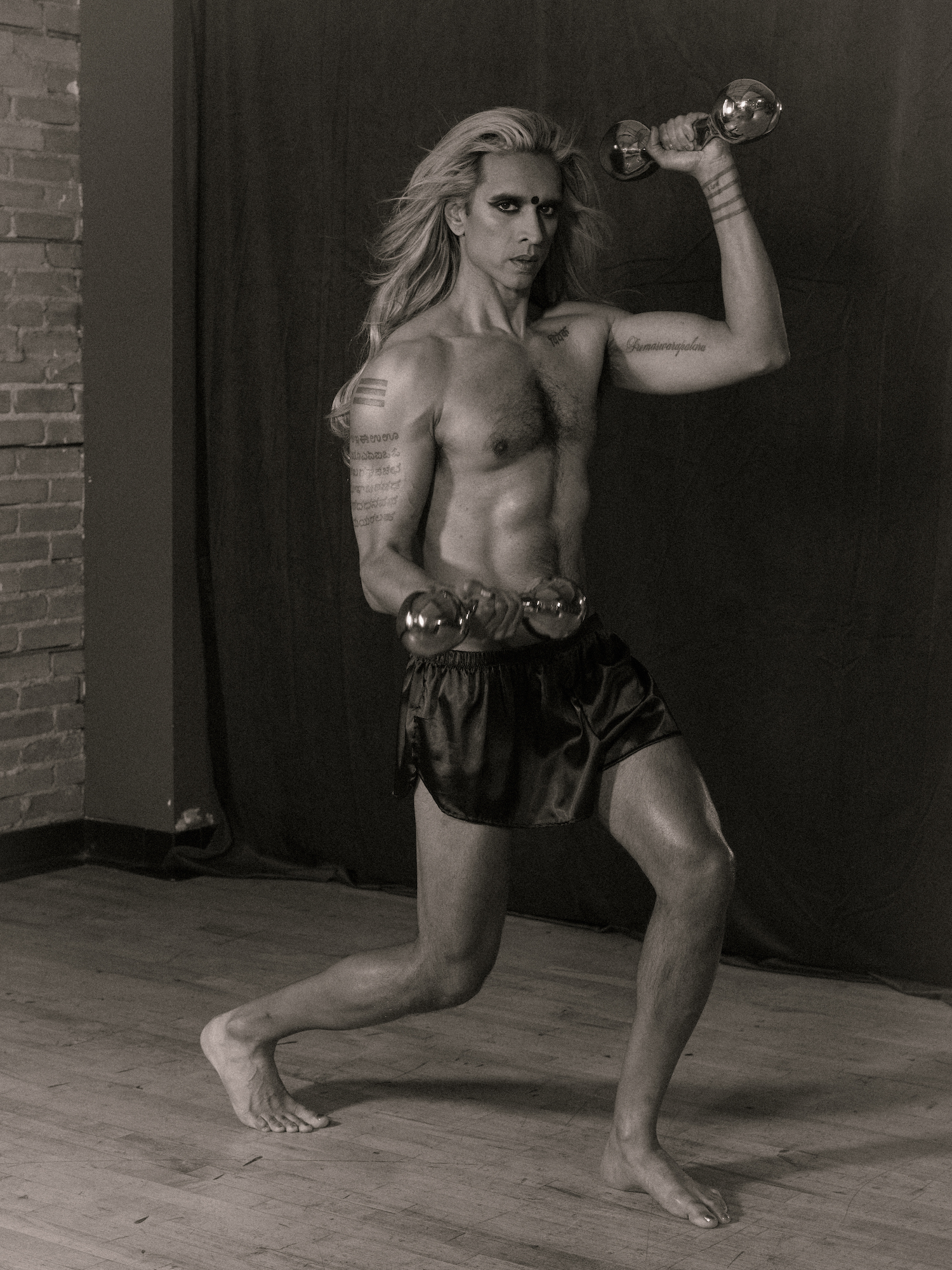
Read an introduction to Bodyrebuilding by Curator Elliott Ramsey
View Project
TRANSCRIPT
On a Thursday morning in 2017, I was fired - for speaking up about microaggressions I had witnessed and experienced in my workplace. After listening to my report, my manager's boss coolly reframed my complaints: “We hear you when you say that you aren't a good fit here anymore.” She told me that I should not return to work on Monday - adding that the institution would pay me for two more months as long as I didn't share what I had told her with anyone else.
At that point, I had been working at the institution for fifteen years, the last ten years in this particular office, where I loved the work I was doing - until a change in management radically altered the environment.
I should mention that the job I was fired from was a diversity office - the place where fellow employees were encouraged to report experiences of discrimination. This is one of the reasons why, to this day, I need a trigger warning when I hear the word “diversity.”
I was so stunned by this turn of events - by being sent out the back door without a proper goodbye or any acknowledgement of the years of work I had put in, that my entire right shoulder, arm and hand froze - I couldn't lift my arm, bend my elbow, or even move my fingers.
I immediately saw a chiropractor and physiotherapist who were thankfully able to unfreeze me. But since that day, my body has never been “pain free.” From then onwards, I would have a dull throbbing ache in my neck and sometimes head - plus tingling from my fingers all the way up my elbow deep into my armpit, every time I used the computer for longer than fifteen minutes. Sometimes these symptoms would kick in after ten minutes. Sometimes five. Soon these pains also started to flare up whenever I typed on my phone.
Needles terrify me, so I found myself wondering during treatment: which is worse, pain or needles?
Given that my main professions are writing and teaching and that our communication in the twenty-first century is mediated by technology, computers and phones are necessary parts of my life. I familiarized myself with dictation software and began sending voice memos to minimize the amount of time I spent typing - but it was impossible to avoid the computer altogether. Over time, just the thought of the computer, of a big project deadline, would give me anxiety. And unfortunately, stress, I would soon learn, only exacerbated my symptoms.
I decided to seek out professional help again. I started regularly seeing a physiotherapist who did various forms of manual treatment and needling on me. Needles terrify me, so I found myself wondering during treatment: which is worse, pain or needles? I also saw a chiropractor. Then another physiotherapist. All while seeing several massage therapists. I saw an acupuncturist who informed me, during a treatment while his female cousin was in the room assisting him, that I could prevent hair loss if I stopped ejaculating. I saw another acupuncturist who treated my body like his personal pincushion. I saw a manual therapist who told me stories about his time in the Russian army and how good he was with kalashnikovs while my head was locked under his arm. I braced myself for the moments when homophobia might reveal itself in his words - or worse, his actions.
I tried to stick with each therapist for a month or two to give their treatments a solid chance to work before I moved on to the next. But this came at a cost. I was privileged to have some benefits through my new job, but they ran out quickly. Over the past seven years, I have spent thousands of dollars, out of pocket, on every kind of practitioner available to try to end, or minimize, or at least understand, my pain. I also paid a variety of ergonomic specialists to assess my work stations and bought a range of ergonomic keyboards and mouses, testing each one to see if they would lessen my pain symptoms.
I eventually saw my physician, who recommended a sports doctor, who recommended nerve testing. The final diagnosis was that I was “healthy.” I was then referred to a nerve specialist who temporarily relieved my pain by stabbing my neck and head with dental freezing every few weeks.
I continued this cycle of appointments and treatments until I saw an osteopath, Joel, who explained that the issue was that my back was weak and recommended that I work with a trainer to strengthen it. He was the first person who clearly articulated to me the difference between stretching and strengthening. Many practitioners had given me stretches—all of which I had done with varying degrees of discipline—but stretches offered only temporary relief. I needed to make a more permanent change.
While I was happy to have a diagnosis I could understand and a new treatment plan, the prescription to go to the gym was unwelcome. I had spent years trying to adhere to Western standards of masculinity by bulking up and had been happy to abandon my tedious weightlifting regime when I transitioned in 2016. Back then I had always worked out in the comfort of my home because gyms were too intimidating. Too many opportunities to compare myself to other bodies, which then morphed into self-hate. But once again, my ongoing pain had the upper hand as my motivator.
I was lucky to find Dawn, a trainer in my neighborhood gym who specializes in injury management and rehab. Together we began working on a plan to strengthen my back and posture. I was astonished to discover how much strength I had lost in the four years I had not been working out. I couldn’t do even the most basic presses without my upper traps instantly flaring up or my pain symptoms kicking in. Dawn gently reminded me that recovery would be slow because I was trying to undo the damage of almost two decades of computer work.
This was the most common explanation for my pain and in many ways it made sense. I remember writing my second novel, lying on my back on the couch with my laptop propped against my knee. Until I started living with chronic pain, I never took “sitting breaks” or even stretched my wrists. I had no idea what my hip flexors or TFL or romboids or C1 were. Instead, I had spent most of my life avoiding knowing my body as a result of my body being shunned, since I was teenager, for being queer.
I reflected on how this activity that was once seen as freakish has, over time, become commonplace, with a gym now on every block. Could this be possible for gender transition as well?
Might that teenage trauma have contributed to this picture of pain, too? Or what about the fact that I had transitioned in 2016, a year prior to the onset of the pain, which heightened my experiences of hatred? Or what about the fact that while I was transitioning, I’d completed a graduate degree - a notoriously taxing experience - that I hoped would get me a new job as a professor so that I could find a better balance between my 9-to-5 day job and the evenings and weekends I spent working at my second job as an artist. Or what about the stress of the $65,000 of debt that was constantly hovering over me from investments I had made in my own art in the absence of institutional support? Or what about the shock of being unjustly fired?
On its own, the diagnosis of “prolonged computer work” ultimately made the pain my fault. And when you’re to blame for your own suffering, or when it’s assumed to be the inevitable result of (over) working and aging, there is no way forward. No way out. But when I began to see myself and my circumstances through a wider lens, I was able to recognize all that my body had been bearing and begin the process of building a new relationship with my body.
Meanwhile, the more I trained in the gym, the more I discovered that I really like being active, being physical. I like that in the gym the task and worry lists disappear, that the only things I can think about are my breath and the weights in my hands. People talk about meditation as a way to be focused and in the present. Going to the gym is my meditation.
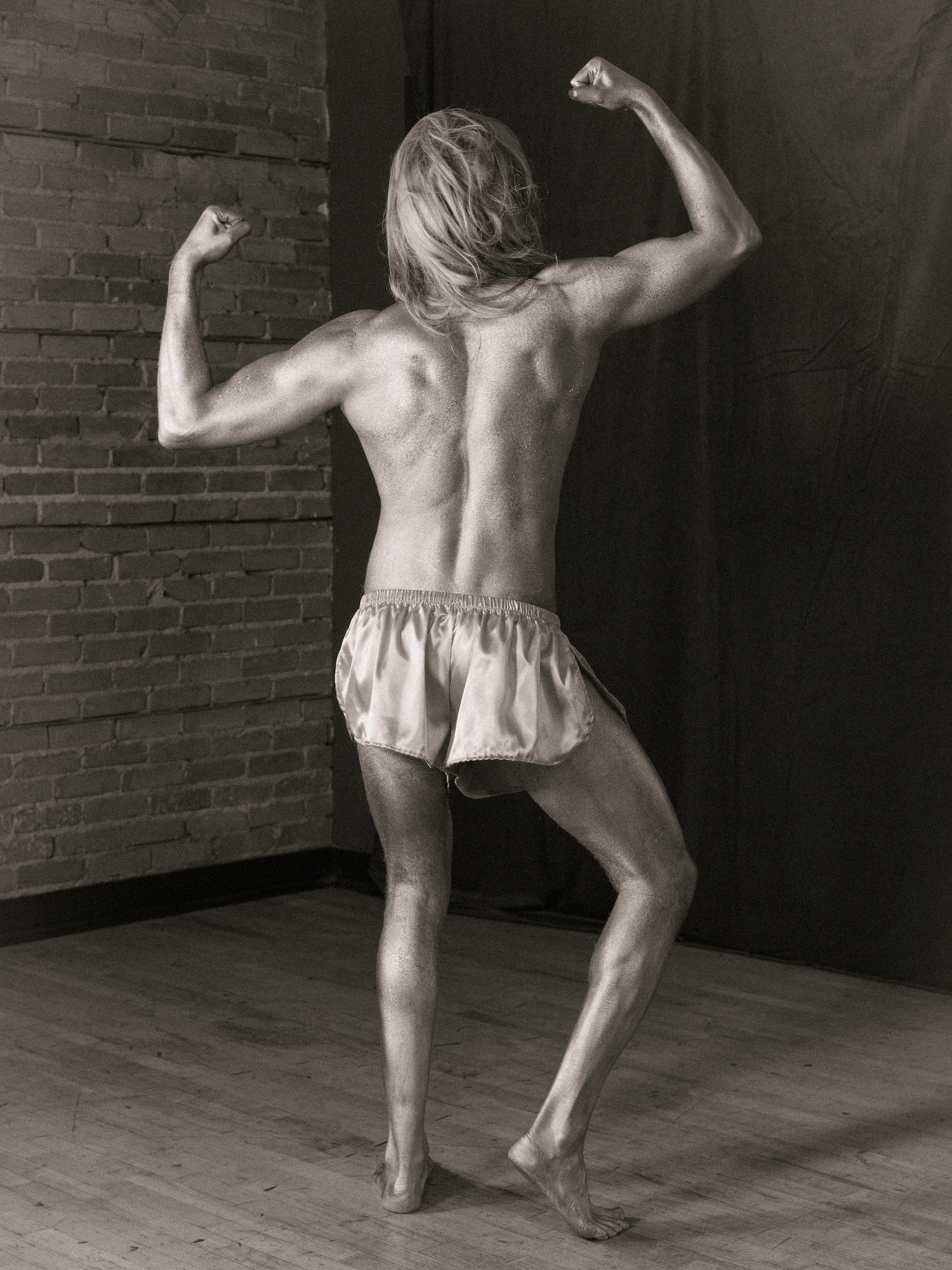
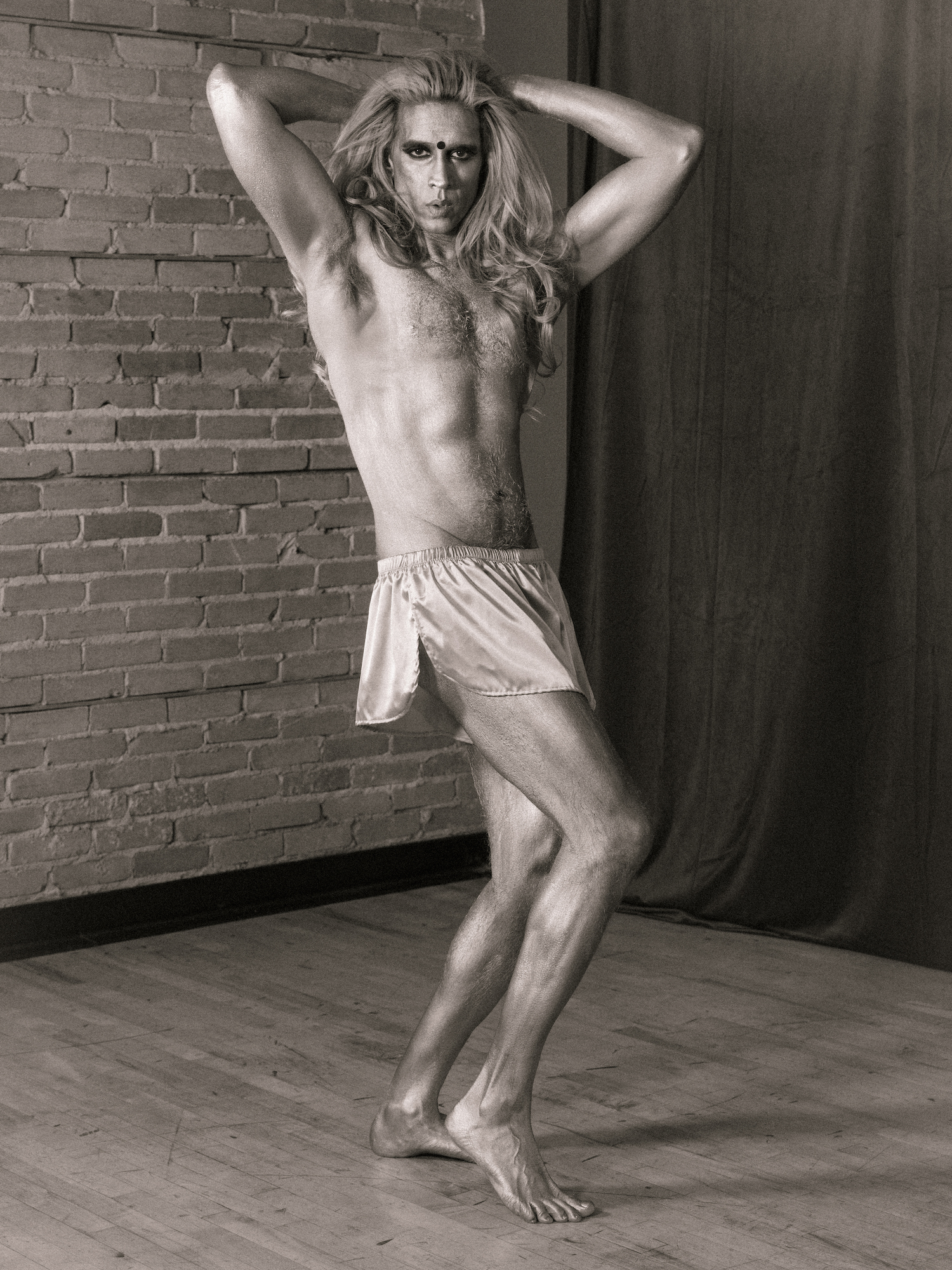
I also love being in a space where physical transformation is normal. Of course, gym culture and the fitness industry can be detrimental in ways I have already alluded to. But as I learned about the history of bodybuilding, I felt an unexpected kinship with the bodybuilders I saw depicted in vintage photos. I reflected on how this activity that was once seen as freakish has, over time, become commonplace, with a gym now on every block. Could this be possible for gender transition as well? Could I use my body to illustrate this possibility? And could I, a trans femme, whose body is seen as both grotesque and as possessing “unfair advantages,” particularly in the realm of sports, reframe the art of bodybuilding?
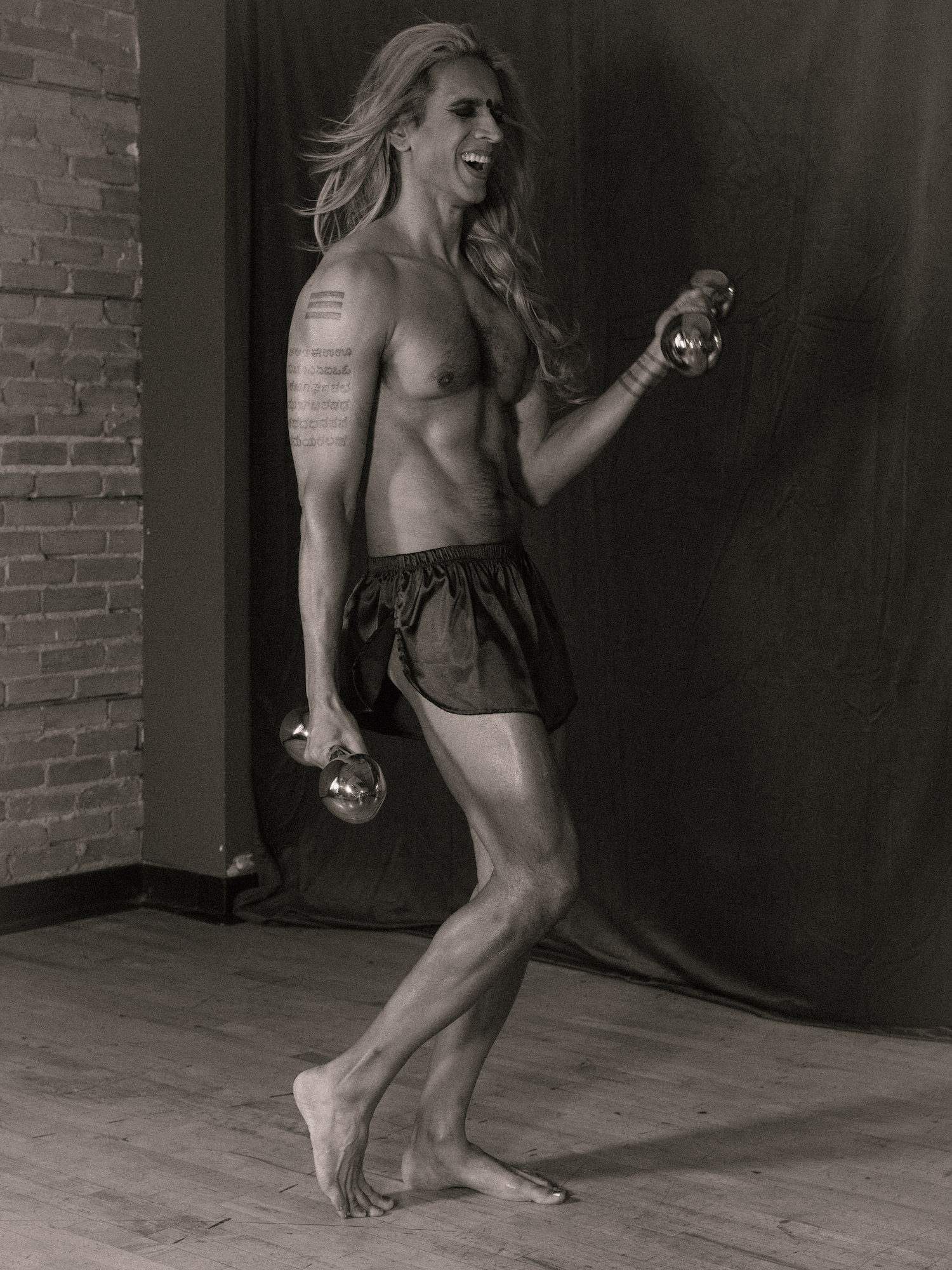
Bodybuilders are also seen as epitomes of strength and power, of indestructibility. From my comparatively limited experience of feeling strong and capable in the gym, I have learned that strength doesn’t diminish or discount the presence of pain, and vice versa. I used to feel depressed because the pains I was experiencing in my late 30s were the kinds I had I assumed would arrive a decade later, at the earliest. It seemed like my body had officially begun the degeneration process. But discovering that my body could hurt when I used the computer but I could also deadlift—that both of these things were true—was comforting and altered my perception of the possibilities ahead of me.
I have spent the seven years since I was fired rebuilding my body and mind, in and out of the gym. For better and for worse, pain has made me both more knowledgeable about my body and hyper aware of it, paranoid about any new minor glitch or ache getting worse.
There are times when I can sit at the computer for thirty minutes, sometimes an hour, without pain. Or at least without the same intensity of pain. I try not to take these times for granted.
I thank my body for working so hard for me and with me. For pushing me to give less to institutions and for reminding me that my body needs me to work for her too.
Created with support from The Polygon Gallery
Creative Direction: Vivek Shraya
Photography and consultation: Zachary Ayotte
Hair and makeup: Alanna Chelmick
Set coaching: Dawn Hart
Set assistant: Adam Holman
Stainless steel weights: Vagujhelyi
Audio engineer: Beau Cassidy
Text editor: Trisha Yeo
Captions: Serene Husni
Artwork & typography: Tim Singleton
Special thank you: Shemeena Shraya, Diego Vagujhelyi, Agnes Vagujhelyi, Helena Krobath, Ariane Laezza, Danny, Jon, Will, Martyn and Joel.
Originals
Collection
Originals are occasional, unique projects, commissioned by and developed in collaboration with Parallelogram and its curators
Monuments
Lawrence Paul Yuxweluptun, Marianne Nicolson
The Fountaincleaners
Charlotte Zhang